
Ragnar Granit Institute, P.O.Box 692, FIN-33101 Tampere, Finland
Editor: Jaakko Malmivuo, www.rgi.fi/persons/malmivuo/, ISSN: 1456-4343
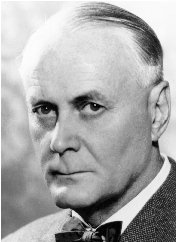
Ragnar Granit
30.10.1900 - 12.3.1991
100 years from the birth of
the Finnish born Nobel Prize winner
|
|
RAGNAR GRANIT
Ragnar Arthur Granit was born on 30th October 1900 in the then Parish of Helsinki
into the family of forestry officer Arthur Wilhelm Granit (born 1871) and his wife Bertie Granit
(born 1878). The Granit family is originally from Korppoo, located in the archipelago of the
south-western Finland. The family home for over 100 years was in Vikminne in Korpoström.
Ragnar Granit's grandfather was a sea captain. During Ragnar's childhood his father looked
after his silviculture firm in Helsinki and the family lived in Oulunkylä.
Ragnar went to school in Helsinki in the Swedish Normallyceum and passed the
matriculation examination in 1919. After matriculation Ragnar first considered starting
law studies and in fact took summer courses in 1919 at Åbo Akademi University
|
in philosophy and Finnish legal language. The summer course in philosophy had a strong
orientation towards psychology and this latter subject completely captivated him. His uncle,
Lars Ringbom, who had a well-developed knowledge of human nature, remarked on this
and said "It's useless to devote oneself to psychology if one does not have a doctor's
training or at least a deep knowledge of biology." And so Ragnar finally chose to study medicine.
Ragnar studied medicine at the University of Helsinki and graduated as Bachelor of
Medicine in 1924. He obtained his doctorate in 1927. The topic of his thesis was the theory
of colour recognition. In addition to his medical studies he obtained a Bachelor of Philosophy
degree in 1924 in the subjects theoretical and practical philosophy, aesthetics and chemistry. |
|
|
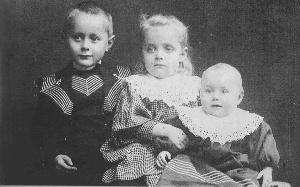
Ragnar, born 1900, Greta, born 1902 and
Ingrid, born 1905.
|
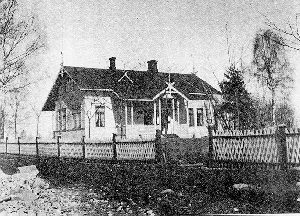
Ragnar Granit's childhood home at Oulunkylä, suburb of Helsinki.
|
|
RAGNAR GRANIT'S FAMILY
Ragnar Granit's spouse, Baroness Marguerite (Daisy) Emma Bruun was born
in 1902 in St Petersburg. Her parents were Councillor of State Baron Theodor Bruun
and Mary Edith Henley. The originally French family had become russianized.
Daisy's father was Head of the Finnish Passport Office. Her mother was English
by birth and always spoke English with the children.
Ragnar met Daisy the first time in 1918. Daisy wove the crown of laurels
used at the conferring of his master's degree in 1923. Ragnar and Daisy
married in 1929 and spent their honeymoon in Philadelphia, where Ragnar had gone
to pursue research. Their son Michael was born in 1930. He is an architect by training
and in 1990 was appointed Professor of Architecture at the Royal Institute of Technology in Stockholm.
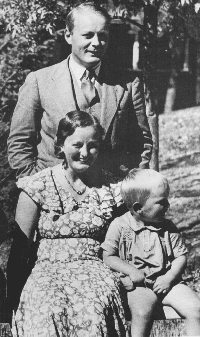
Ragnar, Daisy and Michael Granit at Vikminne, Korppoo, Finland, 1935.
|
RESEARCHER IN HELSINKI, OXFORD AND PHILADELPHIA
In 1928 Ragnar Granit travelled to Oxford University, just two years after
Professor Edgar D. Adrian had been the first to measure the electric impulse
of a single nerve. The most notable nerve physiologist of the time,
Sir Charles Scott Sherrington, was then working at Oxford. Granit wanted to
understand vision and realized that the underlying fact was that the retina itself
functions as a nerve centre which processes visual information and transmits
already processed information to the brain's visual centre.
Using the electric measuring technique developed by Edgar Adrian,
Granit continued bioelectric research at the University of Pennsylvania as
researcher in medical physics from 1929 to 1932. After that he was back
again at Sherrington's laboratory during the years 1932-1933. He continued his
bioelectric research on the visual nerve and the retina, called electroretinogram (ERG),
at the University of Helsinki from 1935 to 1940. Granit's book Sensory Mechanisms
of the Retina published in 1947 is one of the classics in the field of
the electrophysiology of the eye.
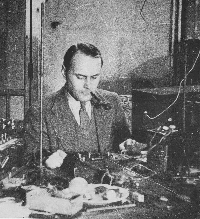
Ragnar Granit at Helsinki University, Instituteof Physiology in the early 1930's.
|
|


|
Page 4
|
|
One of Sherrington's central thoughts was that the effect of nerve signals
on the next nerve cell, via a synapse, can be either activating or inhibiting.
Granit became interested in the idea of being able to demonstrate experimentally
that the retina also contained inhibiting synapses. After leaving Sherrington and
returning home to Helsinki, he succeeded in this experiment. In this work he used
a self-made electron valve amplifier. He published his research results in 1935.
However, this work was not yet applied to a single nerve cell. In his further work,
also carried out in Helsinki, Granit performed an experiment on a single nerve cell.
The preparation involved an isolated frog's eye which had just been opened.
For this he required an extremely small electrode. In his measurements he used
an especially sharp silver needle insulated with a glas capillary tube.
The glas capillary had been melted round the whole silver needle except
for the head of the needle. This type of electrode was the first of its kind
and was to be used later as an instrument in countless other electro-physiological
research experiments.
Granit further pursued the physiological basis of colour perception.
According to his research results, some nerve fibres of the eye are not particularly
selective in the case of colour. On the contrary, they react in the same way
over the whole spectrum. In contrast, other fibres clearly distinguish between colours.
In 1937 Granit published these research results, thus confirming the theory of
colour perception put forward in his own day by Hermann von Helmholtz (1821-1894).
|
Together with another physiologist from Helsinki, Gunnar Svaetichin,
Granit observed that the electric impulses generated in the retina, the so-called
electroretinogram, showed that sensitivity to colour is concentrated mainly in
three different groups in the area of red, green and blue. This provided the first
biological demonstration in support of the Young-Helmholz three-colour theory.
In 1929 Ragnar Granit was appointed Docent in Physiology, and in 1937
Swedish-language Professor of Physiology at the University of Helsinki.
In 1940, when the Winter War between Finland and Russia had ended,
he was appointed Research Professor at Harvard University in the United States.
It is known that he had already bought the travel tickets to the United States
when he received the offer to become Professor of Neurophysiology at
Karolinska Institutet of Stockholm. He decided in favour of the latter.
In 1945 the Neurophysiology Laboratory of the Nobel Institute of Medicine
in Stockholm was founded. He was invited to become its director
and worked in this position until his retirement in 1967.
Ragnar Granit was also Visiting Professor at the Rockefeller Institute
in New York during the years 1956-1966, at St. Catherine's College,
Oxford in 1967, at the University of the Pacific, San Francisco in 1969,
at the University of Düsseldorf in 1975, at the Max-Planck Institute (Bad Nauheim)
in 1976 and at the National Institute of Health (Bethesda, Maryland, USA) in 1971-1972 and 1974.
|
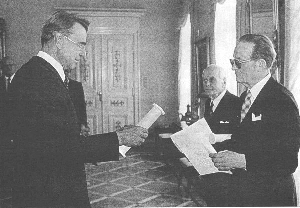
Professors Ragnar Granit and Matti Kuusi receive the honorary degree of Academician from
President of the Republic of Finland, Mauno Koivisto in 1985.
|
|
SCIENTIFIC DISTINCTIONS
Professor Ragnar Granit achieved significant results as a researcher of
bioelectric phenomena, the biophysics of vision and the human nervous system.
Ragnar Granit was awarded the Nobel Prize in 1967, jointly with the American biophysicist
Haldan Keffer Hartline and biochemist George Waldin "for their discoveries concerning
the primary physiological and chemical visual processes in the eye".
This makes Professor Ragnar Granit one of the three Finnish-born Nobelists in addition to
Frans Emil Sillanpää (Nobel Prize in Litterature 1939) and Artturi I.Virtanen (Nobel Prize in Chemistry 1945).
Ragnar Granit also received numerous distinctions and awards from different universities
and research institutes in Finland and around the world. He was nominated Member of the
Finnish Society of Sciences and Letters in 1937 and was later Honorary Member.
He was Member of the Royal Swedish Academy of Sciences from 1944 and its President
during the years 1963-65.
|
He was Member of the Royal Society of Medicine since 1960, Member of the National Academy
of Science since 1968, Honorary Member of the Accademia di Medicina, Turin, since 1961,
Member of the Indian Academy of Science since 1963, Member of the American Academy of
Arts and Sciences since 1971, Member of the Accademia Nazionale dei Lincei, Rome,
since 1978 and member of numerous other academies of science.
Ragnar Granit has also been awarded numerous honorary doctorates, e.g. in Oslo 1951,
Oxford 1956, Lima, Bogotá and Santiago 1958, Hongkong 1961, Chicago 1969, Pisa 1970,
Helsinki 1982 and Göttingen 1987. The Academy of Finland awarded Professor Granit
the title of Academician in 1985.
His scientific awards include, amongst others, the Anders Jahre Prize for medicine
in the Nordic Countries in 1961, the Accademiadi Medicina (Turin) St. Vincent Prize in 1961
and of course the already mentioned Nobel Prize, which crowned his scientific career in 1967.
|
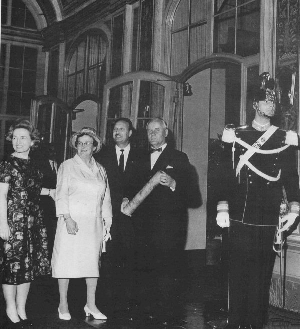
|
Ragnar Granit receiving the
St. Vincent Prize
at Accademia di Medicina,
Turin, 1961.
|
|
|
Ragnar Granit was born a Finn, received his education in Finland and worked
as professor in Finland. He did the scientific work which led to the Nobel Prize in Finland
before moving to Sweden. It was not possible, however, for him to receive the Nobel Prize earlier,
because he was a member of the Nobel Committee by virtue of his professional post.
After his retirement in 1967 the Nobel Committee awarded him the prize for "his work during his youth",
to quote Granit himself.
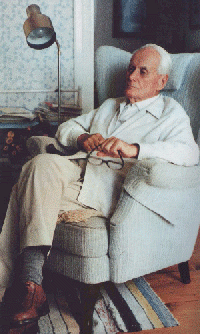
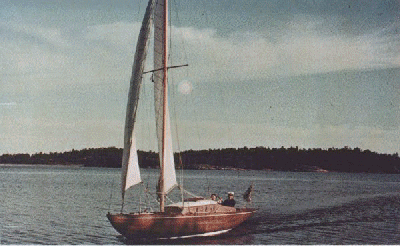
Ragnar Granit faithfully spent his summers until the end of his life in Vikminne in Korppoo.
Until the last years of his life he received the Swedish-language newspaper "Hufvudstadsbladet"
from Helsinki in the morning post and the accent of the Swedish-speaking Finn in his speech was genuine.
Until his death he continued to be a member of the Finnish Society of Physicians.
www.rgs.fi
|
|
|
|
Studia Generalia Lecture Series
Helsinki University,
November 2000
Ragnar Granit Institute and Foundation organized in November 2000 a series of Studia Generalia lectures
at Helsinki University under the title: "100 Years from the Birth of Finnish Born Nobel Prize Winner
Ragnar Granit - Bioelectric Phenomena".
|
The series included four lectures discussing Professor Ragnar Granit, bioelectric phenomena,
electric phenomena in the brain, electric properties of the senses, electric properties of the heart.
In each lecture, both biomedical engineering and medical aspects were discussed by specialists
from the Ragnar Granit Institute and Helsinki University Central Hospital. Each lecture was participated by about 200 persons.
|
|
Jari Viik defended
his Doctoral Thesis
October 6th 2000
Diagnostic Properties of
Exercise Electrocardiographic Leads and
Variables in the Detection of
Coronary Artery Disease
The dissertation study compared the diagnostic properties of the standard exercise ECG leads.
It examined the effect of the number and selection of leads on the diagnostic properties of
ST and heart rate (HR)-adjusted ST variables. It also assessed the diagnostic properties of
novel ST/HR hysteresis in the detection of CAD. The thesis was based on 7 articles published
in recognized international journals.
According to the results, the diagnostic properties of leads I, -aVR, V5 and V6 are
most influential, whereas the those of leads aVL and V1 are insufficient in the detection of CAD.
The use of a fixed cut-off criterion for each individual lead is inappropriate. The reproducibility
of the ECG variables is poor. The diagnostic properties of ST/HR hysteresis are significantly
better than those of the other exercise ECG variables used. The diagnostic performance of
the exercise ECG can be significantly improved by computerized analysis of the heart rate-adjusted
ST depression pattern, including recovery phase and paying more attention to the lead chosen for ECG analysis.
Professor Ramesh Gulrajani, Hopital Sacre-Coeur, Montreal, Canada, and Dr. Olle Pahlm,
Lund University Hospital, Lund, Sweden, served as examiners for Jari Viik. Professor Jaakko Malmivuo
served as Custos.
|
Päivi Laarne defended
her Doctoral Thesis
October 17th 2000
Implementation of a Realistic
Conductivity Model for the Head
The EEG inverse solution, i.e., specifying the equivalent current dipole parameters, was studied.
It was based on the application of the reciprocity theorem and lead field theory to determine the forward solution,
i.e., calculating the electric field attributable to known sources in a realistic conductivity model of the head.
Realistically shaped volume conductor data was applied in modeling the electric fields in the head.
The software implemented for the forward solution and calculation of the lead fields was validated.
Two inverse algorithms for single equivalent dipole localization were tested using simulated potential data.
The effects of tissue resistivities on both the accuracy of dipole localization and the lead fields were studied.
It was found that the correct skull resistivity value is needed for accurate dipole localization.
An individual realistic head model can be constructed to calculate the electric volume conduction
in the tissues of the head, and with correct resistivity data it is possible to study normal brain function
and to assist the diagnosis of various dysfunctions.
Professor Maria Peters, University of Twente, Enschede, The Netherlands, and
Dr. Riitta Salmelin, Helsinki University of Technology served as examiners for Päivi Laarne.
Professor Hannu Eskola served as Custos.
|
|
|
|
Page 8
|
|

Season's Greetings
The personnel of the Ragnar Granit Institute thank all their friends
for good co-operation during 2000 and wish everyone a
Merry Christmas and a successful New Year 2001.
|
 Index Index
 Ragnar Granit Institute Ragnar Granit Institute
|
|

